

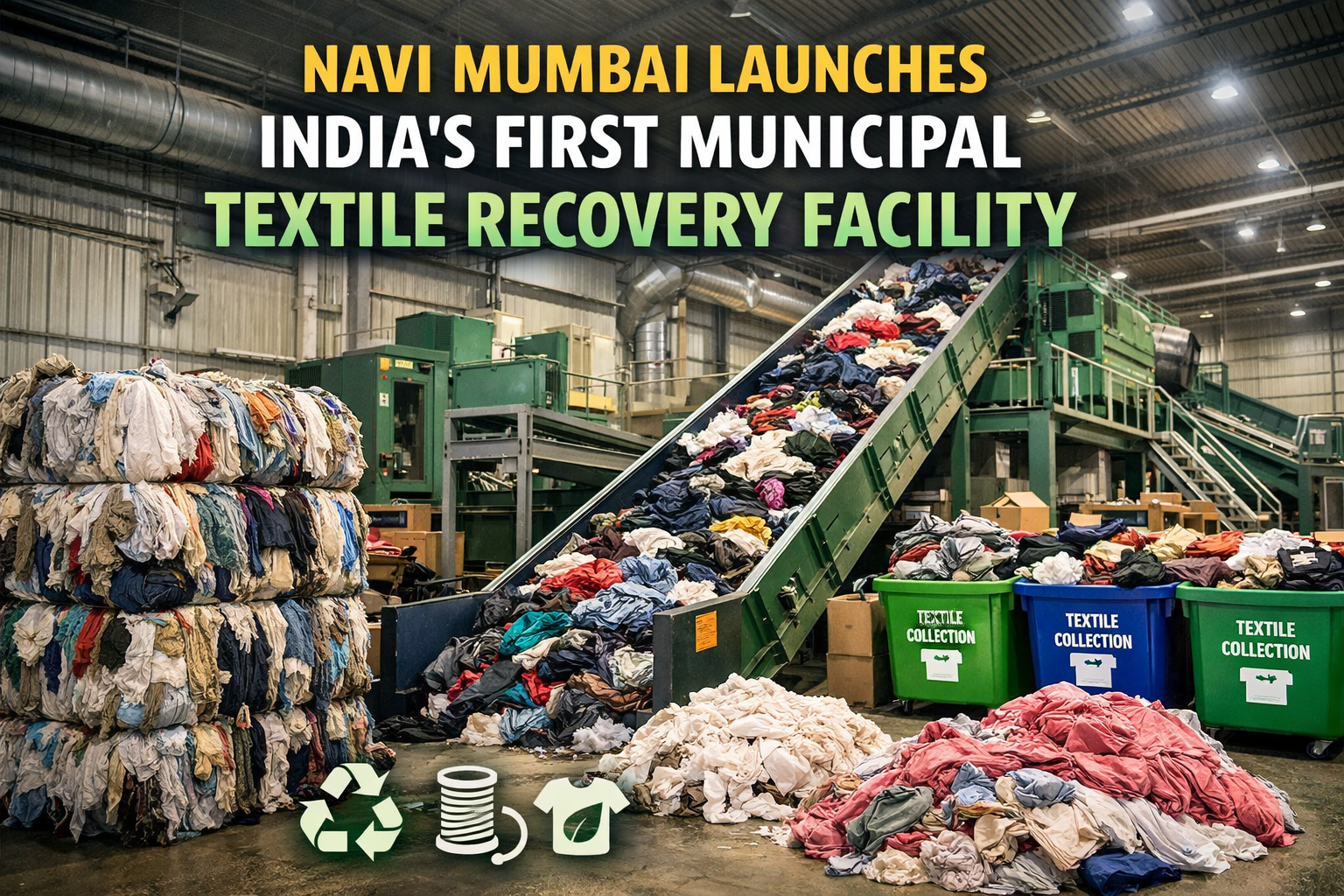
NMMC’s Belapur unit has processed 30 MT of textile waste while employing over 150 women from self-help groups.
Navi Mumbai Municipal Corporation Leads India in Textile Waste Recovery Under Swachh Bharat Mission
Navi Mumbai has become home to India’s first Municipal Textile Recovery Facility (TRF), established by the Navi Mumbai Municipal Corporation (NMMC) under the Union government’s Swachh Bharat Mission–Urban 2.0. Located in Belapur, the facility marks a significant step in tackling India’s growing textile waste crisis — the country currently generates nearly 7.8 million metric tonnes of post-consumer textile waste every year, making scientific recovery and reuse an urgent national priority.
The facility operates through a network of 140 branded textile collection bins deployed across housing societies in all 8 municipal wards of Navi Mumbai, with the current phase targeting a total of 250 bins. Waste collected is processed using a KOSHA handheld scanner capable of real-time fibre identification, covering materials including cotton, polycotton, polyester, wool and silk. So far, the TRF has collected 30 metric tonnes of post-consumer textile waste, of which 25.5 metric tonnes have been scientifically sorted. The facility processes an average of nearly 500 items per day, with over 41,000 items handled to date. Community outreach has been substantial — the initiative has reached more than 1,14,575 families, conducted over 75 IEC (Information, Education and Communication) workshops, and onboarded more than 350 society representatives.
One of the most notable dimensions of the Belapur TRF is its focus on women’s economic empowerment. More than 300 women have undergone structured 8-day Training-of-Trainers modules in textile handling and product development. Of these, over 150 women are now actively earning between ₹9,000 and ₹15,000 per month through work in textile sorting, stitching and product transformation. Women from self-help groups have developed over 400 upcycled product samples — including bags, mats, accessories, apparel and home décor items — that have been showcased at more than 30 exhibitions and public events. The initiative also includes an experimental pilot batch of paper manufactured from rejected textile waste that cannot be sorted or reused in conventional ways.
The NMMC has outlined plans for a permanent, higher-capacity Textile Recovery Facility at Koparkhairane, near Nisarg Udyan, as the next phase of this initiative. The Belapur model, built under a national urban sanitation mission, is being closely watched as a replicable framework for other Indian cities grappling with the dual challenge of mounting waste and underemployment among urban women. If scaled effectively, municipal textile recovery could reshape how Indian cities manage a waste stream that has, until now, received far less policy attention than plastic or organic waste.
NewsBreak24 Note: As Indian cities expand their waste management mandates under Swachh Bharat Mission–Urban 2.0, the Navi Mumbai model demonstrates that textile waste — long overlooked — can generate meaningful livelihoods while reducing environmental burden.