

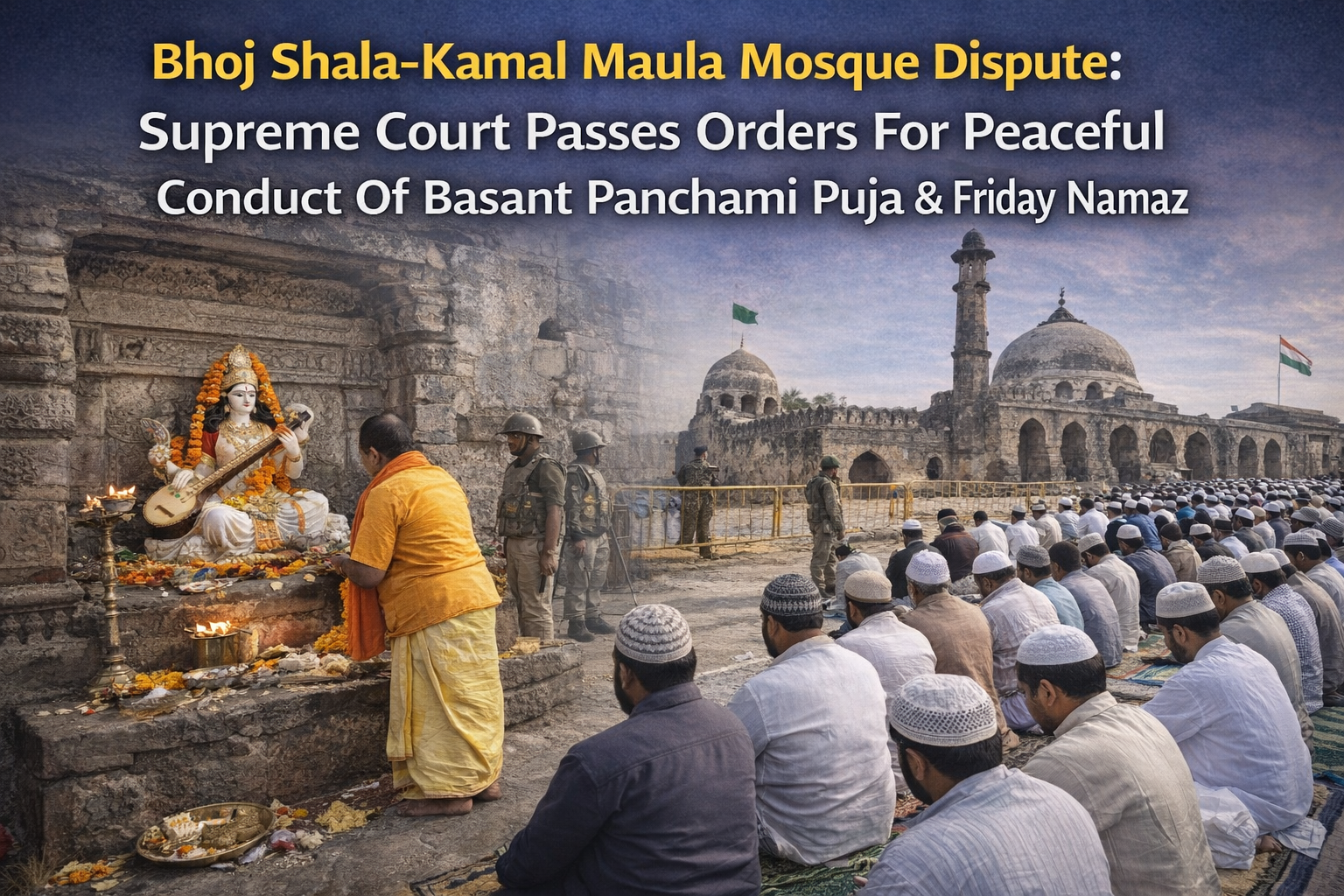
The Supreme Court of India on Thursday issued crucial directions to ensure both Basant Panchami celebrations and Friday Namaz are conducted peacefully and without conflict at the Bhojshala-Kamal Maula complex in Dhar, Madhya Pradesh — a location that remains at the heart of a sensitive religious dispute.
Historic Site with Dual Significance
The Bhojshala-Kamal Maula structure, a protected 11th-century archaeological site, holds deep religious importance for both Hindus and Muslims. Hindus revere it as a temple dedicated to Goddess Saraswati (Vagdevi), while Muslims recognize it as the Kamal Maula Mosque. A 2003 arrangement had allowed Hindus to worship on Tuesdays and Muslims to offer Friday prayers — a tenuous balance that faces fresh challenges each time major religious occasions coincide.
Supreme Court Intervenes Ahead of Basant Panchami
With Basant Panchami falling on January 23 this year — a significant festival for Hindus associated with Goddess Saraswati — tensions flared over the use of the site. The Hindu Front for Justice filed an application in the Supreme Court seeking permission for continuous worship throughout the day, from sunrise to sunset.
Appearing for the applicants, Advocate Vishnu Shankar Jain emphasized the religious importance of uninterrupted rituals. On the other hand, Senior Advocate Salman Khurshid, representing the mosque management, highlighted that Juma Namaz must be performed between 1 PM and 3 PM, as per Islamic requirements.
Court’s Resolution and Key Directions
A bench led by Chief Justice Surya Kant, along with Justices Joymalya Bagchi and Vipul Pancholi, offered a balanced solution:
-
Separate enclosures will be designated within the Bhojshala complex for Basant Panchami puja and Friday Namaz.
-
The Muslim community must provide the estimated number of worshippers to the district administration, who may issue entry passes and arrange separate ingress and egress routes.
-
The administration has been empowered to take any other fair measures to prevent conflict or disruptions.
In its order, the court urged both communities to “exercise mutual respect” and fully cooperate with local authorities to maintain law and order during the sacred observances.
Pending Legal Matters and Survey Report
The directive came in connection with an ongoing Special Leave Petition by Maulana Kamaluddin Welfare Society, which challenges a Madhya Pradesh High Court order that had directed the Archaeological Survey of India (ASI) to survey the complex.
The Supreme Court had previously allowed the survey with a condition that no excavation or alterations be made. It also ordered that no actions based on the survey results could be taken without the Court’s approval.
On Thursday, the Court disposed of the pending SLP, directing that the High Court should now take up the matter for final hearing. The ASI’s sealed survey report may be opened, shared with parties, and reviewed in presence of legal representatives for transparency.