
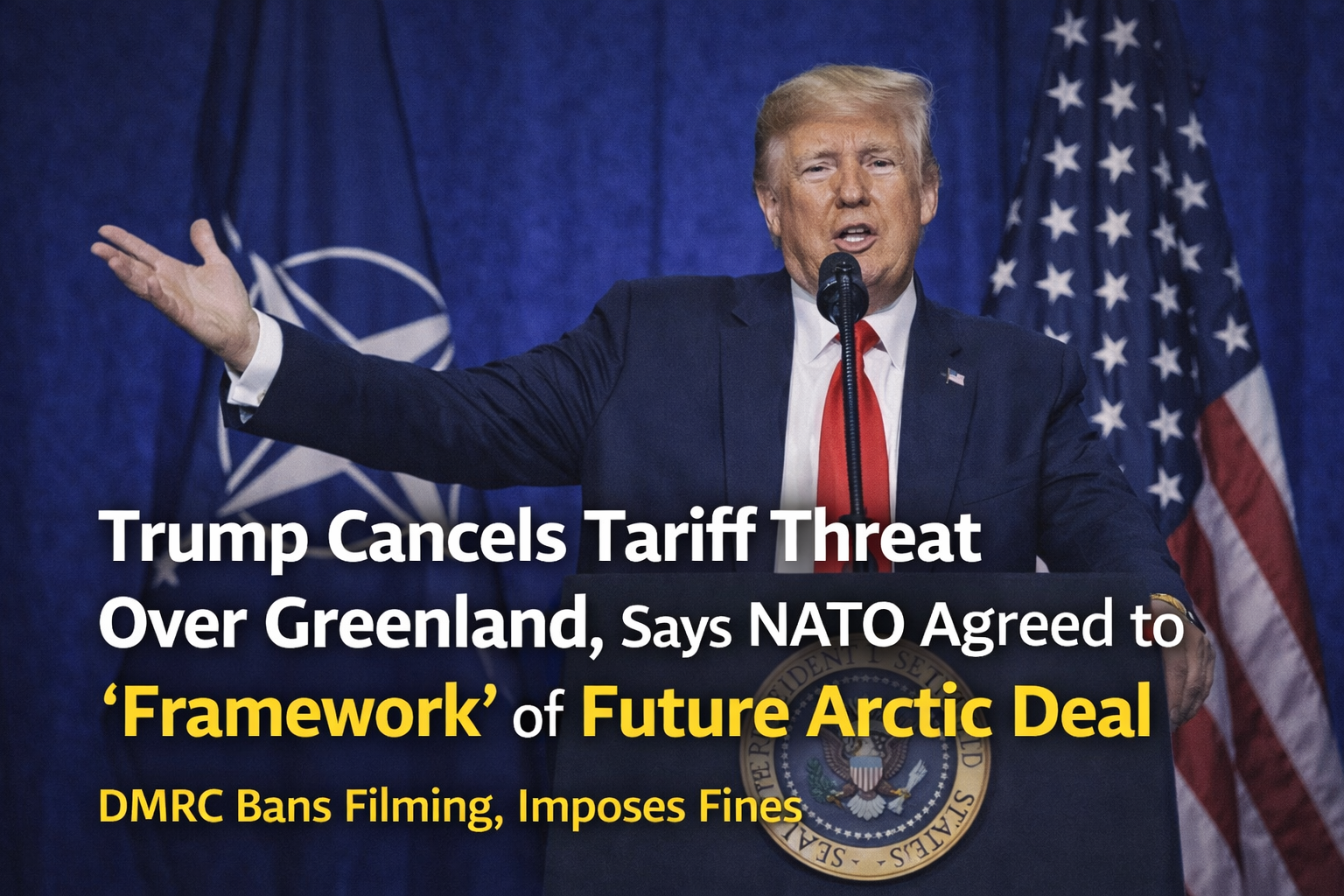
U.S. President Donald Trump makes an abrupt policy shift on Greenland amid diplomatic tensions, signals future Arctic security cooperation with NATO.
A Surprise Policy U-Turn at the World Economic Forum
In a dramatic reversal, U.S. President Donald Trump announced on Wednesday (January 21, 2026) that he would cancel a controversial plan to impose tariffs on European allies over U.S. intentions to acquire Greenland. The announcement came just hours after Trump delivered a striking speech at the World Economic Forum in Davos, Switzerland, where he claimed NATO had agreed to a broad “framework” for a future Arctic security deal.
Trump, known for his bold diplomatic tactics, had previously doubled down on the idea of acquiring Greenland, stating the U.S. seeks “right, title, and ownership” of the strategically located Arctic territory. However, he clarified that he would not pursue this goal through military force—at least for now.
“We probably won’t get anything unless I decide to use excessive strength and force… but I won’t do that,” Trump told attendees, later adding, “I don’t want to use force.”
NATO and Denmark Respond
The President’s rhetoric has sparked fresh concerns within the NATO alliance, a bloc that has remained a geopolitical cornerstone since the Cold War. European leaders have repeatedly reaffirmed that Greenland—an autonomous territory within the Kingdom of Denmark—is not up for sale.
Responding to Trump’s comments, Danish Foreign Minister Lars Lokke Rasmussen acknowledged the importance of avoiding military escalation, but criticized the broader narrative.
“This is a way of thinking about territorial integrity that doesn’t align with modern institutions,” Rasmussen said. “Greenland is part of NATO, as is Denmark. We will exercise our sovereignty accordingly.”
A Danish official, speaking anonymously to The Associated Press, confirmed Denmark’s willingness to discuss Arctic security but stressed that “red lines” regarding sovereignty must be respected.
Greenland Reacts, Citizens Urged to Prepare
In Nuuk, Greenland’s capital, residents took no chances. The local government issued a preparedness handbook in both English and Greenlandic, advising citizens to stock up on essentials like food, water, and fuel in the event of a crisis.
“Just threats… but it’s better to be ready than not ready,” said local resident Tony Jakobsen, showing bags filled with emergency supplies.
The handbook includes instructions to prepare for at least five days of isolation or disruption, highlighting just how seriously local authorities are taking the situation.
Trump’s Arctic Ambitions and Economic Comparisons
Trump’s aggressive posture over Greenland is rooted in strategic concerns. The Arctic region has become a new frontier in global politics, with Russia and China stepping up their presence. Although the U.S. already operates a significant military base in Greenland, Trump has argued that full control is necessary for “national and international security.”
He also framed the issue as a transactional one, emphasizing U.S. contributions to NATO over the years.
“It’s a small ask compared to what we have given Europe for many decades,” Trump said.
Without naming a monetary offer, he hinted that the “price” for acquiring Greenland was less about dollars and more about global safety.
Summit Drama and the Global Stage
Trump’s remarks at the World Economic Forum weren’t limited to geopolitics. He contrasted the U.S.’s strong economic performance with what he described as a “fizzling” European economy.
“We want strong allies, not seriously weakened ones,” he said. “You all follow us down, and you follow us up.”
Despite some protests along the motorcade route—including signs critical of the President—Trump received polite applause from the standing-room-only crowd of global leaders and business executives.
After his speech, he met privately with leaders from Poland, Belgium, and Egypt. When pressed about possible military intervention in Greenland, he reiterated: “Military is not on the table.”