
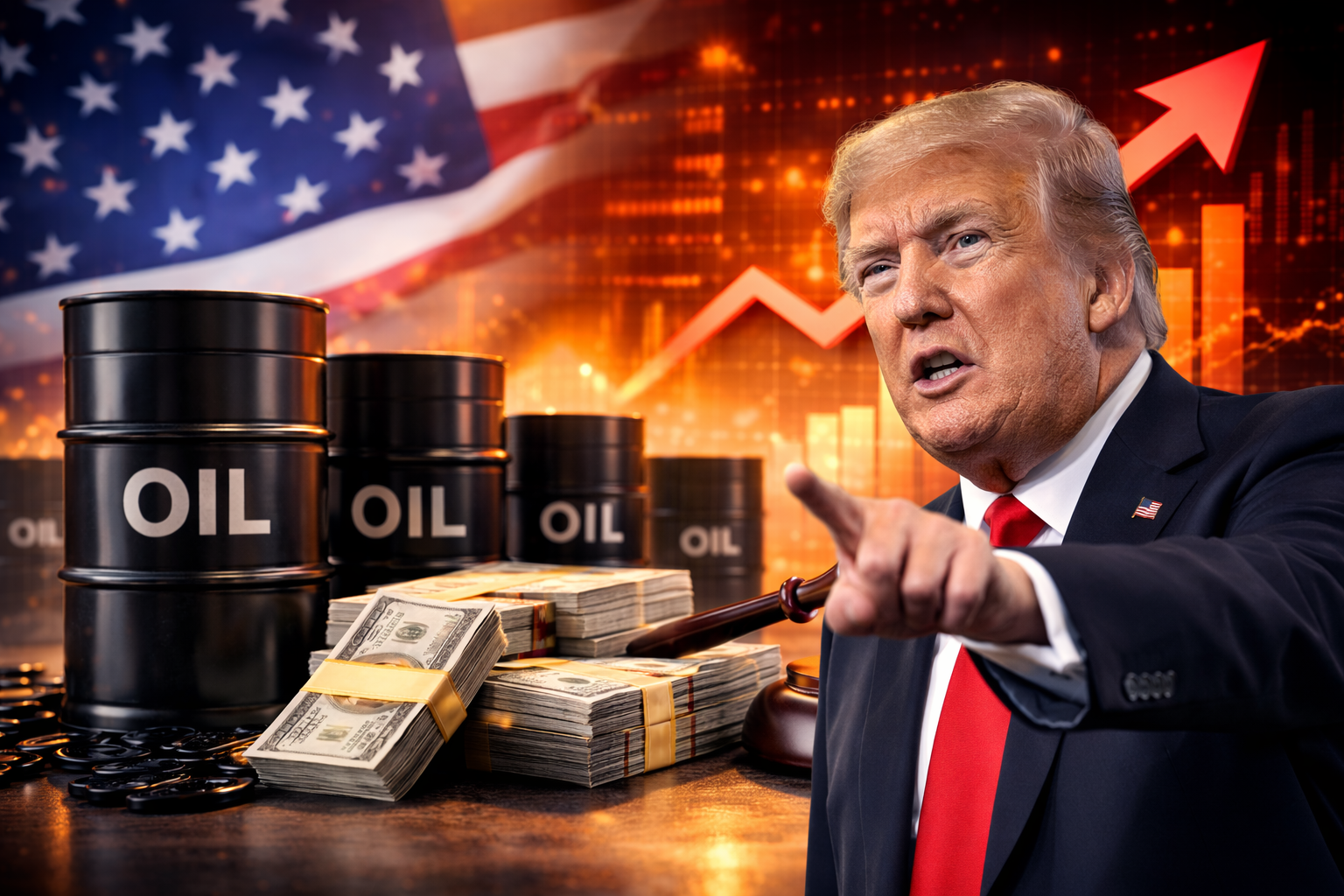
U.S. President Donald Trump has backed a bill imposing up to 500% tariffs on Russian oil imports and announced the U.S. withdrawal from the India-led International Solar Alliance, just days before new Ambassador Sergio Gor arrives in Delhi.
In a significant geopolitical move, U.S. President Donald Trump has approved a bill proposing up to 500% tariffs on countries continuing to import Russian oil, while also confirming the United States’ withdrawal from the India-led International Solar Alliance (ISA). These actions come just days ahead of U.S. Ambassador-designate Sergio Gor’s arrival in Delhi, intensifying pressure on India’s strategic energy decisions.
🇺🇸 A Double Blow to India’s Energy Diplomacy
The announcement, made on January 8, 2026, signals a tougher stance by the Trump administration against countries seen as facilitating Russia’s oil revenues amid the ongoing Ukraine war. India, which has been a key importer of discounted Russian crude, now finds itself navigating a difficult diplomatic path between energy security and global pressure.
Senator Lindsey Graham, a key Trump ally, confirmed that the Russia Sanctions Act has now been greenlit by the president and may be passed in Congress as early as next week. With overwhelming bipartisan support—84 senators and 151 house co-sponsors—the bill is expected to sail through.
“This legislation gives the president leverage against nations like India, China, and Brazil who are still purchasing Russian oil,” Graham said. “It’s time we act to stop indirectly funding Putin’s war machine.”
🛢️ India Already Scaling Back Russian Oil Imports
Reacting to the developments, Indian refiners appear to be preemptively cutting back. Reliance Industries, a major private-sector buyer, has reportedly not received Russian crude at its Jamnagar refinery since early December and is not expecting any in January.
Government-run oil companies had ramped up imports in November 2025, but with Reliance and Nayara Energy both dialing back, India’s overall intake is set to decline. This mirrors a similar pattern from 2018, when India completely halted imports from Iran and Venezuela under pressure from the Trump administration.
Ambassador Sergio Gor, who officially begins his tenure on January 12, has previously stated that “ending Indian purchases of Russian oil is a top priority”. Gor will also serve as Special Envoy to South and Central Asia, indicating a broader diplomatic mandate in the region.
☀️ U.S. Exit from the Solar Alliance: A Climate Setback?
In a parallel development, the U.S. also withdrew from the International Solar Alliance (ISA), a flagship initiative co-founded by India and France and headquartered in Delhi. The alliance, launched in 2015 during the Paris Climate Summit, now includes more than 90 member nations and was seen as a major push toward global solar energy adoption.
The withdrawal has been described by analysts as a major setback to multilateralism and global climate cooperation. Trump also announced the U.S. will exit more than 60 international organizations, including the UN Framework Convention on Climate Change.
While the Indian government has not issued an official response to the ISA withdrawal, External Affairs Minister S. Jaishankar faced indirect criticism from Polish Foreign Minister Radoslow Sikorski during a press conference in Paris. Sikorski expressed “satisfaction” at India reducing its Russian oil imports, calling it a step toward isolating Russia economically.
🛑 What’s Next for India?
The arrival of Ambassador Gor comes at a delicate moment. As India seeks to balance strategic autonomy with deepening trade and security ties with the West, Trump’s escalating pressure may reshape India’s energy strategy and force new diplomatic recalibrations.
Whether India will “zero out” its Russian oil purchases once again, as it did in the past, remains to be seen. But with 500% tariffs on the table, the stakes are higher than ever.